The Bergeron model is based on a distributed LC parameter travelling wave line model, with lumped resistance. It represents the L and C elements of a PI Section in a distributed manner (i.e. it does not use lumped parameters). It is roughly equivalent to using an infinite number of PI Sections, except that the resistance is lumped (1/2 in the middle of the line, 1/4 at each end).
Like PI Sections, the Bergeron Model accurately represents the fundamental frequency only. It also represents impedances at other frequencies, except that the losses do not change. This model is suitable for studies where the fundamental frequency load flow is most important (i.e. relay studies, load flow, etc.).
NOTE: See Selecting the Proper Line Model for more details on whether the Bergeron model is right for your study.
|
More: |
|
Use Damping Approximation? |
|
Choice |
|
Select Yes or No. This option can be used to approximate damping at a specified high frequency |
|
|
|
|
|
|
|
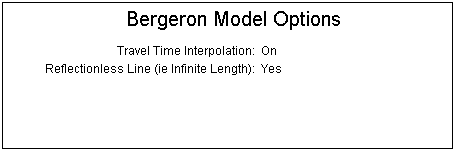
Interpolate Travel Times? |
|
Choice |
|
Select Yes or No. When modeling shorter transmission lines, travel times should be interpolated. |
|
|
|
|
|
|
|
Frequency for Loss Approximation |
|
REAL |
Literal |
Enter the frequency for loss approximation. This frequency should be much greater than the line base frequency. This parameter is enabled only if Use Damping Approximation? | Yes is selected [Hz] |
|
|
|
|
|
|
|
Shaping Time Constant (0 Seq. Mode) |
|
REAL |
Literal |
Enter the shaping time constant. See Multi Conductor Model for more details. This parameter is enabled if Use Damping Approximation? | Yes is selected [ms] |
|
|
|
|
|
|
|
Shaping Time Constant (All Metallic Modes) |
|
REAL |
Literal |
Enter the shaping time constant. See Multi Conductor Model for more details. This parameter is enabled if Use Damping Approximation? | Yes is selected [ms] |
|
|
|
|
|
|
|
Do You Want this to be a Reflection-less Line (i.e. Infinite Length)? |
|
Choice |
|
Select Yes or No. If enabled, the transmission line will be considered reflection-less, or of infinite length.
An example where this option can be used is for lightning overvoltage studies, where it is desired that a strike divide using the correct surge impedance, but the stroke will never reflect from the far end. That is, the travel time of the line is longer then the period over which you want to study. |