
This function simulates a lag or 'real pole' function, where the output can be reset to the user specified value at any instant. The input signal is scaled by the gain factor G(t) before it is processed. The time domain solution algorithm is based on the trapezoidal rule.
The solution method for this function is as follows:
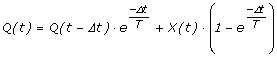
The output is then,

Where,
|
Output signal |
|
Input Signal |
|
Gain factor (can be a variable) |
|
Time constant (can be a variable) |
|
Time step interval |
More: |
Name for Identification |
Text |
Optional text parameter for identification of the component. |
||
Limit Output? |
|
Choice |
|
Select Yes or No |
|
|
|
|
|
Fortran Comment |
|
Text |
|
An optional Fortran comment. The text entered here is included in the project Fortran file |
|
|
|
|
|
Resettable? |
|
Choice |
|
Select Never, Anytime or Timezero.
Choosing Timezero will allow for the assignation of an initial value. |
|
|
|
|
|
Reset Value |
|
REAL |
Variable |
Enter the value to which to reset the output. |
Gain |
|
REAL |
Variable |
Gain factor |
|
|
|
|
|
Time Constant |
|
REAL |
Variable |
Time constant [s] |
Maximum |
|
REAL |
Variable |
Limits the output to this maximum |
|
|
|
|
|
Minimum |
|
REAL |
Variable |
Limits the output to this minimum |


