This component models a rechargeable, electrochemical battery.
Secondary electrochemical batteries (i.e. rechargeable batteries) are of great importance in power systems because they provide a means for storing small quantities of energy that is easily accessible if needed. Some of the main uses for batteries are:
There are many types of batteries and many factors that affect battery performance. To predict the performance of batteries, different mathematical models exist. None of them are completely accurate, nor do any include all necessary performance effecting factors. This battery model is based on the method proposed in reference [26]. This method is a general approach, in which an ideal controlled voltage source, in series with a resistance, is used to model the battery.

Battery Equivalent Circuit
At every time step, the voltage of the controlled source is computed, based on the state of charge of the battery using two different methods. The first method is based on a non-linear equation (shown below) that uses the actual state of the battery to calculate the no-load voltage. The value of the resistance is assumed to be constant.
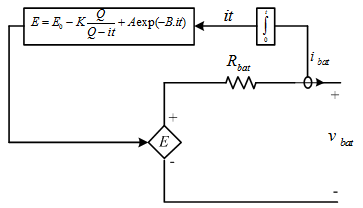
Non-Linear Battery Model
Where:
E |
No-load voltage [V] |
E0 |
Battery constant voltage [V] |
K |
Polarization voltage [V] |
Q |
Battery capacity [Ah] |
|
Actual battery charge [Ah] |
A |
Exponential zone amplitude [V] |
B |
Exponential zone time constant inverse [1/Ah] |
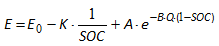
The battery voltage equation can be modified as follows in order to be expressed in terms of SOC instead of it:
|
(BATT-1) |
This model is based on a few simplifying assumptions and has some limitations
Assumptions:
Limitations:
More: |
PSCAD General Reference [26] |
Battery Name |
|
Text |
|
Name for the battery (optional). A name should be entered here to avoid compilation warnings. |
|
|
|
|
|
Data Entry |
|
Choice |
|
Select Shepherd Model or Tabular Data. |
|
|
|
|
|
Nominal Voltage |
|
REAL |
Constant |
Enter the nominal voltage of the battery [kV]. |
|
|
|
|
|
Rated Capacity |
|
REAL |
Constant |
Enter the rated capacity of the battery [kAh] |
|
|
|
|
|
Loss of Capacity at Nominal Current in an Hour |
|
REAL |
Constant |
The nominal discharge current, for which the discharge curve has been measured [%]. |
|
|
|
|
|
Initial State of Charge |
|
REAL |
Constant |
Enter the initial state of charge of the battery (%) |
|
|
|
|
|
State of Charge |
|
REAL |
Output |
[%] |
Nominal Capacity |
|
REAL |
Constant |
Enter the nominal capacity based on rated capacity [pu]. |
|
|
|
|
|
Resistive Drop |
|
REAL |
Constant |
Enter the voltage drop due at nominal discharge current, as a per unit value of the nominal voltage [pu]. |
|
|
|
|
|
Voltage at Exponential Point |
|
REAL |
Constant |
Enter the voltage at exponential point as a per unit value of nominal voltage [pu]. |
|
|
|
|
|
Capacity at Exponential Point |
|
REAL |
Constant |
Enter the discharge capacity at exponential point based on rated capacity [pu]. |
|
|
|
|
|
Fully Charged Voltage |
|
REAL |
Constant |
Enter the fully charged voltage based on nominal voltage [pu]. |
Discharge Curve of Battery VoltageDischarge Curve of Battery Voltage
State of Charge (SOC) # |
|
REAL |
Constant |
Enter the state of charge (SOC) of this point in the battery voltage curve [%]. |
|
|
|
|
|
Voltage (V) # |
|
REAL |
Constant |
Enter the voltage of this point in the battery voltage curve [kV]. |
Discharge Curve of Internal ResistanceDischarge Curve of Internal Resistance
State of Charge (SOC) # |
|
REAL |
Constant |
Enter the state of charge (SOC) of this point in the battery internal resistance curve [%]. |
|
|
|
|
|
Resistance (R) # |
|
REAL |
Constant |
Enter the resistance of this point in the battery internal resistance curve [kV]. |