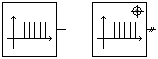
The impulse generator can be used to determine the frequency response of linear control systems. An impulse train can be generated at a specified frequency.
Several impulses should be allowed to pass through the control system before analysis is attempted, to allow the transient response to diminish. Alternately, the frequency can be set to zero, sending only one impulse through the system, and the impulse response may be observed.
If Interpolation Compatibility is enabled, then interpolated information is generated by the device each time an impulse is issued. The interpolated time corresponds to the exact time of the impulse, and is non-zero whenever the impulse does not fall exactly on the time step grid. This effectively removes the time step dependence of the device, which will maintain accuracy even if the time step is increased.
More: |
Name for Identification |
Text |
Optional text parameter for identification of the component. |
||
Frequency of Impulse Train |
|
REAL |
Constant |
Number of impulses per second. A value of zero will result in only one impulse at the time of the first impulse |
|
|
|
|
|
Time of First Impulse |
|
REAL |
Constant |
Time at which the first impulse will occur [s] |
|
|
|
|
|
Height of Impulse |
|
REAL |
Constant |
Impulse magnitude |
|
|
|
|
|
Height in |
|
Choice |
|
Select impulses or units. If Height in Impulses is selected, the height will be given as the height of impulse divided by time step. If Height in Units is selected, the height will be given simply as the height of impulse |
|
|
|
|
|
Interpolation Compatibility |
|
Choice |
|
Select Disable or Enable. See Description for more details. |