
This component may be used to model either a single, or a three-phase p-section transmission line model.
A p-section is primarily used to represent a very short overhead transmission line or underground cable. Although a p-section representation will provide the correct fundamental frequency impedance, it will not accurately model properties at other frequencies. In other words, p-sections provide a simplified means to represent transmission systems for steady-state studies (such as a load flow), but do not provide an accurate, full-frequency transient response.
A p-section is formed by using lumped R, L and C elements, based on information entered by the user. The R and L elements are represented in matrix format and thereby provide coupling between the three phases. There is also both a mutual capacitance C and a capacitance to ground Cm at each end:
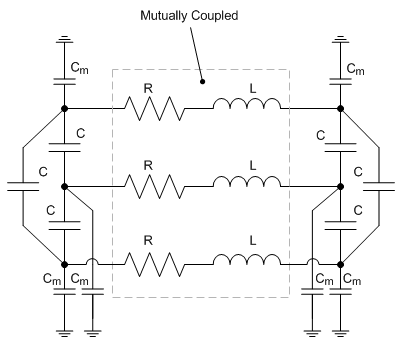
Coupled P-Section Representation in PSCAD
|
More: |
Basic Overview Of Modelling Techniques Constructing Transmission Line Systems |
Main ConfigurationMain Configuration
|
T-Line Name |
|
Text |
|
Just an identifier. A name should be entered here to avoid compilation warnings |
|
|
|
|
|
|
|
Single or Three Phase |
|
Choice |
|
Select Single phase or Three phase. |
|
|
|
|
|
|
|
Enter Impedance/Admittance Data in |
|
Choice |
|
Select R,X,B (pu), R,Xl,Xc (pu), Zsurge,Tau..., R,Xl,Xc (Ohms), or R,L,C (ohm, H, uF). This of course depends on the format of your data! |
|
|
|
|
|
|
|
Line Rated Frequency |
|
REAL |
Constant |
Enter the system rated frequency [Hz]. |
|
|
|
|
|
|
|
Line Length |
|
REAL |
Constant |
Enter the p-section line length [m]. |
|
|
|
|
|
|
|
Enter 0 Seq. Data or Estimate |
|
Choice |
|
Select Enter or Estimate. Select Enter if you have the zero-sequence data. If not, you may estimate the zero-sequence by providing ratios in the Zero Sequence Estimation Parameters dialog. |
|
|
|
|
|
|
|
Sequence R / Positive Sequence R |
|
REAL |
Constant |
Enter the ratio of zero sequence resistance to positive sequence resistance. |
|
|
|
|
|
|
|
0 Sequence Z / Positive Sequence Z |
|
REAL |
Constant |
Enter the ratio of zero sequence surge impedance to positive sequence surge impedance. |
|
|
|
|
|
|
|
0 Sequence Travel Time / Positive Sequence TAU |
|
REAL |
Constant |
Enter the ratio of zero sequence travel time to positive sequence travel time. |
|
Voltage |
|
REAL |
Constant |
Enter the RMS line-line voltage (for three phase) RMS line-ground voltage (for single phase) used for calculating pu values [kV]. |
|
|
|
|
|
|
|
MVA |
|
REAL |
Constant |
Enter the MVA used for calculating pu values [MVA]. |
|
|
|
|
|
|
|
Resistance |
|
REAL |
Constant |
Enter the resistance [pu/m]. |
|
|
|
|
|
|
|
Inductive Reactance |
|
REAL |
Constant |
Enter the inductive reactance [pu/m]. |
|
|
|
|
|
|
|
Capacitive Susceptance |
|
REAL |
Constant |
Enter the capacitive susceptance [pu/m]. |
|
|
|
|
|
|
|
Capactive Reactance |
|
REAL |
Constant |
Enter the capacitive reactance [pu*m]. |
Data in ohm, H and FData in ohm, H and F
|
Resistance |
|
REAL |
Constant |
Enter the resistance [W/m]. |
|
|
|
|
|
|
|
Inductive Reactance |
|
REAL |
Constant |
Enter the inductive reactance [W/m]. |
|
|
|
|
|
|
|
Inductance |
|
REAL |
Constant |
Enter the inductance [H/m]. |
|
|
|
|
|
|
|
Capactive Reactance |
|
REAL |
Constant |
Enter the capacitive reactance [MW*m]. |
|
|
|
|
|
|
|
Capacitance |
|
REAL |
Constant |
Enter the capacitance [mF/m]. |
Surge Impedance, Travel TimeSurge Impedance, Travel Time
|
Resistance |
|
REAL |
Constant |
Enter the resistance [W/m]. |
|
|
|
|
|
|
|
Travel Time |
|
REAL |
Constant |
Enter the travel time [ms]. |
|
|
|
|
|
|
|
Surge Impedance |
|
REAL |
Constant |
Enter the surge impedance [W]. |
|
|
|
|
|
|
|
Zero Sequence Resistance |
|
REAL |
Constant |
Enter the zero sequence resistance [W/m]. |
|
|
|
|
|
|
|
Zero Sequence Travel Time |
|
REAL |
Constant |
Enter the zero sequence travel time [ms]. |
|
|
|
|
|
|
|
Zero Sequence Surge Impedance |
|
REAL |
Constant |
Enter the zero sequence surge impedance [W]. |