
This component simulates the dynamics of up to 25 masses connected to a single rotating shaft. One mass is normally used to represent the generator, and the electrical torque Te is applied to it. One mass may be used to represent an exciter. The remaining masses represent turbines, and the mechanical torque Tm is divided among them. The resulting speed of the generator Wpu or Wrad is then output, for use as input to the interfaced machine model.
|
More: |
|
Name for Identification |
Text |
Optional text parameter for identification of the component. |
||
|
For Use With... |
|
Choice |
|
Select Synchronous Machine, Induction Machine, DC Machine or PM Machine. |
|
|
|
|
|
|
|
Number of Masses |
|
INTEGER |
Literal |
Enter the number of turbines (1 to 25). If 25 turbines are desired, the exciter mass cannot be modeled. |
|
|
|
|
|
|
|
Machine Total MW |
|
REAL |
Constant |
The 3-phase MW of the machine, to which the multi-mass is attached [MW] |
|
|
|
|
|
|
|
Electrical Base Frequency |
|
REAL |
Constant |
Enter electrical base frequency [Hz] |
|
|
|
|
|
|
|
Machine Mechanical Synchronous Speed |
|
REAL |
Constant |
Actual speed of the machine [rpm] |
|
|
|
|
|
|
|
Machine Initial Electrical Speed |
|
REAL |
Constant |
Initial speed of the machine [pu] |
|
|
|
|
|
|
|
Unit System Number (see help) |
|
Choice |
|
Select 1 to 10. See the table below for definitions |
|
|
|
|
|
|
|
Initialization switch: 0-Init;1-Release |
|
INTEGER |
Variable |
0-Initialization, 1-Release. Until the switch turns 1 the generator will be spinning at the 'Machine rated speed' or at rated slip. The variable name can come from the one assigned in the synchronous machine under the Output Variables for Controller Initialization section of the input parameters. |
|
|
|
|
|
|
|
Generator Mass Number |
|
INTEGER |
Literal |
Enter the generator mass position number. |
System of Units Table
|
Unit System |
Inertia Constant Ji or Hi |
Mutual Damping MDij |
Spring Constant Kij |
Torque Share TFi |
Self Damping SDi |
|
1 |
lb•ft•ft |
- |
lbf•ft/rad |
pu |
- |
|
2 |
in•lbf•s2 |
- |
lbf•in/rad |
pu |
- |
|
3 |
lb•in•in |
- |
lbf•in/rad |
pu |
- |
|
4a* |
H [s] |
- |
pu |
pu |
- |
|
4b* |
H [s] |
- |
pu/rad |
pu |
- |
|
5 |
kg•m•m |
- |
N•m/rad |
pu |
- |
|
6 |
lb•ft•ft |
lbf•ft•s/rad |
lbf•ft/rad |
pu |
lbf•ft•s/rad |
|
7 |
in•lbf•s2 |
lbf•in•s/rad |
lbf•in/rad |
pu |
lbf•in•s/rad |
|
8 |
lb•in•in |
lbf•in•s/rad |
lbf•in/rad |
pu |
lbf•in•s/rad |
|
9a* |
H [s] |
pu |
pu |
pu |
pu |
|
9b* |
H [s] |
pu |
pu/rad |
pu |
pu |
|
10 |
kg•m•m |
N•m•s/rad |
N•m/rad |
pu |
N•m•s/rad |
*NOTE: Please note that the difference between 4a & 4b and 9a & 9b is the units of the spring constant Kij. The units conversion 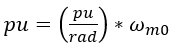 is applied, where wm0 is the rated mechanical speed.
Initialisation Data InterfaceInitialisation Data Interface
|
Output Initialized Mechanical Torque |
|
Choice |
|
Select Yes or No. This input could be used to initialize the governor/turbine and is available only if the For Use With... input parameter is set to Synchronous Machine |
|
|
|
|
|
|
|
Input Initialized Steady Electrical Torque |
|
Choice |
|
Select Yes or No. If the steady state Electrical Torque is available, this could be used to initialize the multi-mass and is available only if the For Use With... input parameter is set to Synchronous Machine. |
Inertia ConstantsInertia Constants
NOTE: The inertia constants must be entered in the units specified in the Unit System Number input parameter
|
Mass # Inertia Constant |
|
REAL |
Constant |
Enter the inertia constant for the corresponding mass |
Shaft Spring ConstantsShaft Spring Constants
NOTE: The spring constants must be entered in the units specified in the Unit System Number input parameter
|
Spring Constant From Mass # to # |
|
REAL |
Constant |
The shaft spring constants are used to describe the dynamics of the shaft. The torque exerted on the adjacent masses by the shaft is proportional to the relative mechanical angles between those masses. |
Torque/Power SharesTorque/Power Shares
|
Torque Share for Mass # |
|
REAL |
Constant |
The total mechanical torque applied to the multi-mass system may be distributed over the individual masses. Each mass receives a fraction of the total mechanical torque: Its torque share. The sum of the torque shares for all masses modeled (except the generator mass) must total 1 (one) [pu]. |
Uniform Model DampingUniform Model Damping
|
Modal Damping for all Modes |
|
REAL |
Constant |
A uniform modal damping factor for all modes. This input is used only for Unit System Numbers 1 to 5. The time constant for the decay of all modal oscillations is inverse of this [1/s]. In order to make the modal damping |
NOTE: The damping constants must be entered in the units specified in the Unit System Number input parameter
|
Mass # Self Damping |
|
REAL |
Constant |
The self-damping coefficient creates a torque on the appropriate mass which is proportional to the speed of the mass. This may be used to represent friction and windage for the mass. |
NOTE: The damping constants must be entered in the units specified in the Unit System Number input parameter
|
Damping Between Mass # & # |
|
REAL |
Constant |
The mutual damping coefficient creates a torque, which is proportional to the difference in speed from one mass to the next. Thus, this torque will not be applied in steady state, but will damp out oscillations between masses. |
Internal Output Variable Names - 1Internal Output Variable Names - 1
|
Torque on Shaft from Mass # - # |
|
REAL |
Output |
Torque experienced by the shaft # [pu]. |
Internal Output Variable Names - 2Internal Output Variable Names - 2
|
Mechanical Position of Mass # Relative to Generator |
|
REAL |
Output |
Mechanical position of mass # with respect to the generator [rad]. |
Internal Output Variable Names - 3Internal Output Variable Names - 3
|
Rated Mechanical Speed of the System |
|
REAL |
Output |
Rated mechanical speed [rad/s]. |
|
|
|
|
|
|
|
Delta Mechanical Speed of Mass # |
|
REAL |
Output |
Difference between the rated speed and the speed of mass # [rad/s]. |