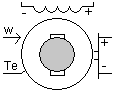
This component models a two winding DC machine. The armature terminals (right side + and -) and the field winding terminals (top + and -) are available as external electrical connections. This enables the simulation of a separately excited machine, shunt machine or a series machine.
The Multi-Mass Torsional Shaft Interface component in the master library can be used along with this model to include the rotor mechanical dynamics.
NOTE: Typical machine connections and the use of the multi-mass model with the DC machine are included as example tutorial cases, included with your PSCAD software. These can be found in the PSCAD installation directory (i.e. ...PSCAD400\examples).
The input and output signals for this component is described as follows:
W: Input mechanical speed of the rotor [pu]
Te: Output electric torque generated by the machine [pu]
More: |
Open Circuit Voltage Characteristics Interfacing to the Multi-Mass Torsional Shaft General Reference [11] |
Name for Identification |
Text |
Optional text parameter for identification of the component. |
||
Rated Armature Voltage |
|
REAL |
Constant |
Enter the rated voltage of the machine [kV] |
|
|
|
|
|
Rated Armature Current |
|
REAL |
Constant |
Enter the rated current of the machine [kA] |
|
|
|
|
|
Rated Field Current |
|
REAL |
Constant |
Enter the rated current of the field winding [kA] |
|
|
|
|
|
Speed at which Magnetizing Data is Specified |
|
REAL |
Constant |
The no load curve (Magnetizing curve) of the machine is specified at this speed [pu] |
|
|
|
|
|
Magnetizing Data |
|
Choice |
|
Select Exponential Equation or Points on V-I curve. The no-load curve (open circuit voltage characteristics) of the machine can be specified either as points (field current, armature voltage) on the curve or in the form of an exponential equation. See open circuit voltage characteristics for more details. |
|
|
|
|
|
Armature Reaction |
|
Choice |
|
Select Neglect AR effects or Include AR effects. Partial de-magnetization of the field flux due to armature current (armature reaction) can be included in the calculations. |
|
|
|
|
|
Multimass Interface |
|
Choice |
|
Select Enable or Disable. See Interfacing to the Multi-Mass Torsional Shaft for more details |
Angular Moment of Inertia (J=2H) |
REAL |
Constant |
This is the total inertia of all masses rotating on the machine shaft (including mechanical loads). If you are provided with the value of the Inertia Constant (H), multiply the value by 2 to obtain the value of J in per unit. [s] or [MWs/MVA]. |
|
Mechanical Damping |
REAL |
Constant |
Enter a value for mechanical damping to compensate for friction and windage loss [pu] |
Winding ParametersWinding Parameters
Armature Resistance |
|
REAL |
Constant |
DC resistance of the armature winding at the rated temperature [W] |
|
|
|
|
|
Armature Inductance |
|
REAL |
Constant |
Self-inductance of the armature winding [H] |
|
|
|
|
|
Field Resistance |
|
REAL |
Constant |
Resistance of the field winding at the rated temperature [W] |
|
|
|
|
|
Field Inductance |
|
REAL |
Constant |
Self-inductance of the field winding [H] |
Armature Reaction DataArmature Reaction Data
NOTE: This data is only enabled if Armature Reaction | Include AR Effects is selected. For more information, see Armature Reaction.
Coefficient b# |
|
REAL |
Constant |
Enter the constants for the armature reaction equation. See Estimation of Armature Reaction Constants for more details [pu] |
Magnetizing Curve - PointsMagnetizing Curve - Points
NOTE: These properties are only enabled if Magnetizing Data is set to Point on V-I Curve. All entries for the magnetizing curve must have positive values. The program will search for the first pair of non-zero, positive values and disregard subsequent entries. If the number of points (N) is less than nine, enter zero or negative values for the (N+1)th entry. The curve should have a positive gradient. If a negative gradient is detected, the program will flash an error and terminate. The gradient should decrease with increasing field current. If the gradient is detected to be increasing, the program will flash out a warning.
Point # - Field Current |
|
REAL |
Constant |
Enter the field current points for the magnetizing curve. All entries must have positive values [pu] |
|
|
|
|
|
Point # - Open Circuit Voltage |
|
REAL |
Constant |
Enter the open circuit voltage points of the magnetizing curve. All entries must have positive values [pu] |
Magnetizing Curve - EquationMagnetizing Curve - Equation
NOTE: These properties are only enabled if Magnetizing Data is set to Exponential Equation. See Open Circuit Voltage Characteristics for more details on setting these properties.
Saturated No-Load Voltage |
|
REAL |
Constant |
Enter the saturated no-load voltage [pu] |
|
|
|
|
|
Saturation Constant |
|
REAL |
Constant |
Enter the saturation constant [pu] |