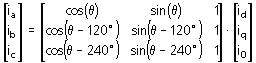
(7-14)
The per-unit system is based on the preferred system indicated in [15]. The base values of voltage and current in the three-phase system is the RMS phase voltage Vao, and RMS phase current ia0. The same voltage base is used in the dq0 system but the base current is 3/2 ia0. The dq0 transformation in per unit for the voltage or current is given in Equation 7-1. The inverse transform is:
|
|
(7-14) |
Note that unit current in the d-winding produces the same total MMF as unit currents acting in a balanced fashion in the abc-windings. Unit currents in the different circuits should produce the same physical effect. In both systems base power is:
|
|
(7-15) |
The associated bases are:
|
|
Rated frequency in radians |
|
|
|
|
|
X |
|
|
|
|
|
|
|
|
|
|
|
|
The impedances are given in per unit for both machines. The input voltages in are divided by Va0 and the incremental time Dt is multiplied by  to provide a per unit incremental time. The per-unit current is converted to output current by multiplying by ia0 after transformation from the two axis-system.
Care should be taken with the following quantities:
Rated torque is not one per unit for the induction motor but is  , which directly relates output mechanical power to input MVA.
  is per unit efficiency,
  is power factor and 's' is the rated slip.
Utilities often specify one per unit field current and voltages as that which produces rated open circuit voltage on the air-gap line (this implies unit power loss in the field circuit). The per unit field current iD2, must be multiplied by XMD0 and then divided by  in order to convert it to the value of field current used in the utility system. The value of the field voltage is multiplied by
  to give the correct per unit value of UD2.


 Base flux linkage
 Base mechanical speed
 Mechanical angle